Convert My Love
The fact that this is a period of forced inactivity for me doesn’t mean indulging in a soft, cushy comfort that doesn’t suit me. I am using this time for all the desk-based activities related to study and gathering information crucial for decision-making. One aspect, in particular, holds significant importance: identifying the most suitable motorcycle. The elements to consider are, in essence, few but require careful comparative evaluation. They boil down to two main aspects: technical-mechanical features and aspects related to functional needs associated with the type of disability. In reality, there’s a third aspect, albeit entirely marginal, yet equally important to me: the aesthetic and sentimental aspect.
Let’s start with the latter. Undoubtedly, the idea of getting back on a motorcycle stems from a profound passion, but there’s more to it. The bond between a motorcyclist and their ride is vastly different from that between a car and its driver. It’s more intimate, more visceral. You can lend your car to your best friend, but never your motorcycle. It’s a connection too exclusive not to have almost morbid characteristics of possession and jealousy. It is, in essence, the human-machine relationship that most closely resembles a great love story. In my case, there’s another aspect: reconnecting with a past that was brutally torn apart by a traumatic event. This means starting again from where it was interrupted, and since mine was a Moto Guzzi from the 1980s, today’s choice must also be a Guzzi from that period. Obviously, this complicates things enormously because it narrows down the available options. But what can you do? I’m an incurable romantic.
Now, let’s look at these options. Let’s begin with the technical considerations. Today, motorcycles, concerning transmission, fall into two broad categories: motorcycles with manual transmission and motorcycles with automatic transmission. The gearbox ensures the transmission of power from the engine to the driving wheels and is responsible for adapting the wheel rotation speed to the force (or torque) delivered based on different driving conditions. It hasn’t always been this way. Automatic transmission on motorcycles, compared to the automotive world, has never been hugely successful. In fact, it has always been strongly opposed, even more so since the widespread use of scooters and maxi-scooters with continuously variable transmission (CVT). For a motorcyclist, the scooter is almost a blasphemy: it’s not that they don’t consider a scooter rider; they simply don’t see them, and feelings range from indifference to visceral hatred. However, today, many manufacturers are adopting automatic transmissions in motorcycles as well. From this perspective, Honda takes the lead, offering the most advanced solutions and consistently experimenting for years. The reasons for this shift are essentially twofold: the massive introduction of electronics and computer-controlled devices in two-wheelers and the increasingly substantial production of electric vehicles.
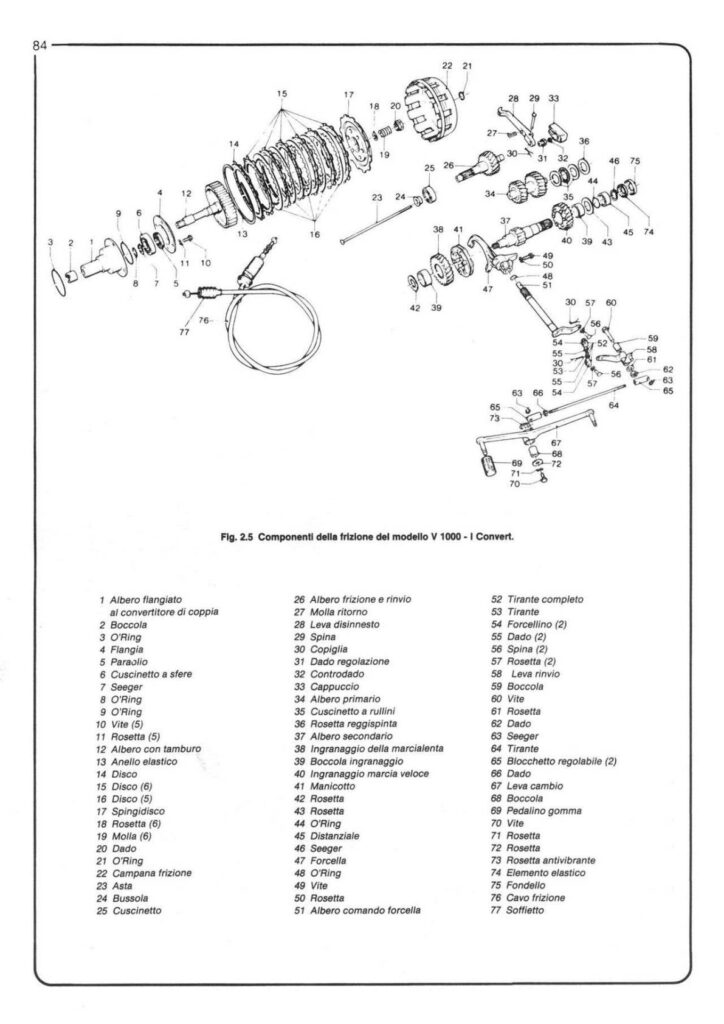
The most common types of automatic transmission are the continuously variable transmission (CVT), mainly adopted in scooters, and the much more performant dual-clutch transmission (DCT). Today, the market offers various models of motorcycles with DCT: from cruisers to off-road bikes to racing setups. In short, there’s something for every taste and budget. However, all these models are at most a decade old. As previously mentioned, I am bound to automatic transmission, and it seems that for those inclined towards a motorcycle from the 1980s, there’s no escape. However, that’s not the case because one solution exists, only one, and it’s a Guzzi. Mandello del Lario, 1970s. In the design office of engineer Lino Tonti, he and his team are contemplating something never attempted before: creating the world’s first automatic transmission specifically designed to be installed on a touring motorcycle. The idea is to meet the needs of the Police Forces (in Italy, for example, the Corps of Cuirassiers, often involved in honor escorts where it’s necessary to maintain slow, fluid, and regular paces that would challenge manual transmission for both riders and mechanical components) and enter the U.S. market. Thus, the Moto Guzzi V1000 Idroconvert is born. Needless to say, it was a failure, but the extremely high rate of innovative solutions remains. In addition to the automatic transmission, the Convert is equipped with an integral braking system developed in collaboration with Brembo for the racing department and later adopted by all subsequent models, along with an engine increased to the generous size of 1000 cc for the first time. The design is in the purest Guzzi style with meticulously crafted details and an abundance of chrome. The shift to a larger displacement became necessary due to the hydraulic automatic transmission that “consumes” power and torque, requiring an additional horsepower boost. The power output thus increases from 67.6 HP at 6800 rpm to 70 HP at 6500 rpm, with an increase in torque at low revs more than sufficient to compensate for the transmission’s absorption.
And now, let’s explore the most innovative feature. The automatic transmission has two gears: the first allows speeds from 0 to 130 km/h, and the second from 0 to approximately 170 km/h. To alter the configuration, it’s sufficient to use the rocker-type shift lever with the left foot, following the activation of the clutch lever. The clutch lever, furthermore, also acts as a safety device to be engaged at the moment of starting to prevent any forward movement of the motorcycle. The other significant innovation is the integral braking. Typically, motorcycles have three braking discs – two on the front wheel and one on the rear wheel – but on Guzzi, everything changes. In the Brembo integral system, the pedal simultaneously activates the rear disc and the left front disc, while a brake force distributor divides the power more forcefully on the front without ever causing a lock-up; the other is controlled as usual with the lever on the handlebar. The rear disc also serves a safety function: a mechanical jaw closes automatically when the side stand is opened, providing a parking brake for parking on slopes without the risk of the motorcycle moving. According to reviews, riding this motorcycle is straightforward and intuitive, and despite its weight, it proves incredibly stable, agile, and easy to handle. The shorter gear ratio is used in urban and narrow mixed routes, while the longer one is suitable for extra-urban roads and highways. The seating is extremely comfortable. Naturally, there are also disadvantages compared to a motorcycle with manual transmission. The Convert requires a revision of the normal driving technique because the converter tends to slip during rapid accelerations, and engine braking is not controllable. Acceleration, in fact, is slow and lacks the instantaneous response or pickup of a manual transmission. This is because power is transmitted from the engine through a fluid (oil) forced by a snail/centrifuge that is shot onto the gears, making them turn. When the throttle is closed, up to 70 km/h, engine braking is weak, but the problem manifests below 70 km/h: a situation that requires generous use of the brakes on descents. The solution is to open and close the throttle a little earlier than usual.
After this long but necessary overview, let’s move on to the other adaptations to be made. Apart from swapping the control blocks from left to right with the control devices (indicators, turn signals, etc.) and installing the servo-assisted clutch button, there are very few other things to change in the original model. The main one is replacing the handlebar with one from the California model, which, with wider and longer arms, increases the leverage, allowing for maintaining balance with minimal effort. In conclusion, there are still a couple of things I need to understand – such as whether applying the brake is sufficient to prevent forward drift when idling or if it’s necessary to disengage the clutch to prevent the engine from stalling – but most decisions have been made. In fact, if anyone has suggestions, information to share, or even knows of a Convert for sale, please write in the comments: I would be truly grateful. For now, that’s all. Until next time.
Technical Specifications (from motociclismo.it)
Engine: 90° V-twin 4-stroke; bore x stroke 88×78 mm, total displacement 948.8 cc; compression ratio 9.2:1; maximum power 70 CV at 6,500 rpm; valve distribution with pushrods and rockers, camshaft in the V of the cylinders operated by a duplex chain.
Ignition: battery-powered with two breakers and automatic advance: initial advance 2°, automatic advance 31°, total advance 33°; contact gap 0.37-0.43 mm; long-root spark plug with a thermal grade of 225 on the Bosch scale, electrode gap 0.6 mm.
Starting: electric with 12 V/ 0.7 HP starter, electromagnetic engagement with a button.
Transmissions: primary with gears, ratio 1.157 (19/22); secondary with shaft, double universal joint, and gears, ratio 3.778 (9/43); total transmission ratios: primary 6.12, secondary 4.589 with the converter reduction ratio referred to the maximum power regime.
Clutch: multiple dry discs.
Gearbox: constant mesh with 2 gears always engaged; internal gear ratios: first 1.333 (18/42), second 1 (22/22).
Frame: double closed cradle disassemblable in steel tubes.
Suspensions: front telescopic fork Moto Guzzi with built-in hydraulic shock absorbers, 50 cc of oil per leg; rear swinging fork with a pair of telescopic hydraulic shock absorbers.
Wheels: alloy spoke rims WM 3/2, 15×18” with a safety profile against tire slip (safety rim); Metzeler tires 4.10H18 or 110/90H18, front inflation pressures 2.1 bar, rear 2.4/2.6 bar.
Brakes: hydraulic system with 3 discs and two interconnected calipers (integral system); two front discs of 300 mm, rear disc of 242 mm; mechanical parking brake on the rear disc activated by opening the side stand.
Electrical system: 12 V with Bosch G1 14 V-20 Ah alternator; 12 V-32 Ah battery; asymmetric front headlight of 170 mm with a bilux lamp 45/40 W, sidelight bulb 5 W, rear light with 2 bulbs 12 V-5/21 W type R19; indicator lights for generator, oil, etc. 12 V-3 W spherical; two acoustic alarms, 5 fuses of 16 Ah.
Dimensions and weight: length 2,200 m, wheelbase 1,470 m, handlebar width 870 cm, handlebar height 1,090 m, seat height 810 cm, footrest height 290 cm, minimum ground clearance 150 cm; curb weight without accessories approximately 261 kg.
AMI Service – Aggiustatori Meccanici Italiani
Concessionaria ufficiale e officina autorizzata Moto Guzzi – Aprilia
via Tiburtina, 251 00162 Roma
www.motoguzzi-roma.it
facebook.com/AMI.Guzzi.Roma
Harold and Maude (Hal Ashby), 1971